Clearances from Corners: Are Outside-of-the-Box Set-Ups Still Effective in Women’s Football?

Clearances from corners have become an increasingly important part of modern defensive organisation. During the recent Women’s European Championships, one moment in the England vs France match highlighted a tactical detail that is worth closer analysis: England positioned three players on the edge of the penalty area, rather than attacking the first delivery inside the box.
These players were not directly competing for the initial ball. Instead, they were positioned to attack second balls and recover clearances. This raises an important tactical question: is committing players to the edge of the box still an effective strategy, or are improving defensive clearances making this approach obsolete in women’s football?
To investigate this, I used freely available event data from Hudl StatsBomb, processed and analysed in RStudio, focusing on the 2025 Women’s European Championship. I isolated instances of clearances made directly from corners and used the recorded x and y location data to map where those clearances landed.
Graph 1 shows the landing locations of direct clearances from corners for each team during the 2025 competition:
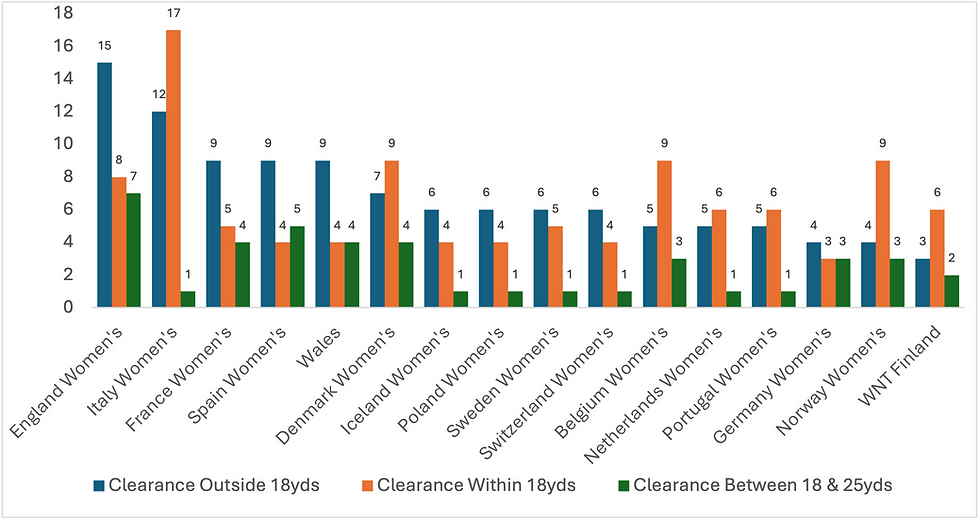
The initial team-level analysis identified seven teams whose clearances frequently failed to travel beyond the 18-yard line. However, across the tournament, most clearances did travel beyond the penalty area, a trend observed in eight of the competing teams.
France, England’s opponent in the match that inspired this analysis, recorded nine clearances during the tournament that successfully travelled beyond the 18-yard line. This raises a key tactical consideration: was France an opponent against whom the “edge of the box” set-up was less likely to be effective?
To explore this further, I focused on the three teams with the highest volume of clearances that failed to clear the 18-yard line: Belgium, Denmark, and Italy. For each team, I visualised both the location of their clearances and whether they retained possession afterwards.
Italy:

Italy recorded the highest proportion of short clearances, with 60% of their clearances failing to travel beyond the 18-yard line. However, their clearances showed a relatively wide spatial spread. While many remained short, a notable number were directed wide rather than central.
This suggests that, although Italy often failed to clear the penalty area completely, they were sometimes successful in moving the ball away from central, high-risk zones.
Denmark:
Denmark’s pattern differed. Their clearances were more frequently played centrally and tended to land closer to the 18-yard line itself.

This pattern is tactically significant. A team facing Denmark may gain greater value from stationing players on the edge of the box because the most likely landing zones for second balls align closely with those positions.
In contrast, this reduces the potential effectiveness of the strategy when facing teams who clear wider, as England attempted against France.
However, when compared to the previous tournament in 2021, clearance effectiveness and distance has been increasing.
Graph 2 shows the landing locations of direct clearances from corners for each team during the 2025 competition.

When comparing the two graphs, the below trends are quite clear to see:
Metric | Women's Euros 2021 | Women's Euros 2025 | Trend |
Avg. Clearances Outside 18yd Box (%) | 44% | 51% | Significant Increase |
Avg. Clearances Within 18yd Box (%) | 56% | 47% | Significant Decrease |
Total Clearance Volume | 241 | 218 | Slight Decrease |
Avg. Clearances to 18-25yd Zone | 28 | 42 | Large Increase |
In 2021, most clearances (56%) remained within the 18-yard box. In that tactical context, positioning players on the edge of the penalty area would likely have been an effective strategy to regain second balls and sustain pressure.
However, by 2025, this trend had shifted. The proportion of clearances travelling beyond the 18-yard line increased from 44% to 51%, indicating that defenders are now clearing the ball with greater distance and consistency.
The findings suggest that the effectiveness of positioning players on the edge of the box is potentially becoming less effective.
Against teams that clear centrally and short (e.g., Denmark), the tactic remains highly relevant. Against teams that clear longer or wider (e.g., France), the tactical returns are reduced. Rather than abandoning the strategy entirely, it may be that this tactic is used against specific teams who make shorter and less effective clearances.
The data indicates a clear trend: defensive clearances from corners in women’s football are becoming longer and more effective. While the “edge of the box” structure may have been an efficient way to capitalise on second balls, its universal effectiveness appears to be declining.
Rather than moving completely away from this approach, teams may benefit more from using it selectively, based on the clearance behaviours of their opponents.
In short, the tactic is not becoming obsolete — but it is no longer universally optimal.


Comments